

Top Things to Consider Before Buying a Voltage Stabilizer for Your AC
We’ve all been there: it’s the peak of summer, the heat is unbearable, and just as your air conditioner kicks into high gear, the lights flicker. The cooling drops, the compressor struggles, and you’re left wondering if your expensive AC is about to bite the dust. Voltage fluctuations—both spikes and brownouts—are more than just an annoyance; they are silent killers for appliances. Modern air conditioners are packed with sensitive electronic circuit boards (PCBs) and advanced compressors that require a steady flow of clean power. If you want to protect your investment and ensure uninterrupted cooling, a voltage stabilizer isn’t optional—it’s a necessity. Here is exactly how to choose the right one for your home. 1. Match the Tonnage: The Load Capacity The most critical factor in choosing a stabilizer is its capacity, which is measured in KVA (Kilo-Volt-Amperes) or Amperes. For air conditioners, stabilizer capacity is directly tied to the cooling capacity (tonnage) of the AC. If you buy an under-powered stabilizer, it will frequently trip or overheat. If you buy an over-powered one, you’re simply overspending. AC Tonnage Recommended Stabilizer Capacity 0.8 Ton to 1.0 Ton 2 KVA to 3 KVA 1.5 Ton 4 KVA 2.0 Ton 5 KVA Pro Tip: If you have a highly efficient 5-star inverter AC or live in an area with extreme voltage drops, always lean toward the higher side of the recommendation (e.g., opting for a 4 KVA stabilizer for a 1.5-ton AC) to give the system a healthy safety buffer. 2. Check the Working Range (The Input Window) A stabilizer works by “boosting” low voltage and “bucking” (lowering) high voltage to keep the output close to the standard 220V–240V range. However, a stabilizer can only correct the voltage if the incoming power falls within its specific Working Range. Before buying, you need to know how bad the voltage drops are in your locality: Check your local power conditions before buying. If your grid drops to 140V and your stabilizer’s range only goes down to 170V, the stabilizer will simply shut off to protect itself, leaving you without AC. 3. Inverter AC vs. Fixed-Speed AC: Does it Matter? A common myth is that modern Inverter ACs do not need a stabilizer because they operate across a wider voltage spectrum. While it is true that inverter compressors handle minor voltage variations better than older, fixed-speed models, their electronic PCBs are highly vulnerable to sudden, sharp voltage spikes or prolonged low-voltage strain. Repairing a fried inverter PCB can cost up to a third of the AC’s original price. The Verdict: Always pair your AC with a stabilizer, regardless of whether it is an inverter or fixed-speed model. Just ensure the stabilizer is explicitly rated compatible with inverter technology. 4. Must-Have Safety Features Don’t just look at KVA and range. A truly reliable stabilizer should act as a fortress for your air conditioner. Look for these four non-negotiable features: Smart Time-Delay System (ITDS) When power goes out and comes back instantly, the compressor needs time to balance its internal gas pressure. The Smart Time-Delay feature ensures that the stabilizer waits for 2–3 minutes before sending power to the AC, preventing compressor failure. High/Low Voltage Cut-off If the grid voltage shoots past 280V or drops below 130V (outside the working range), the stabilizer must automatically cut off power completely to prevent catastrophic electrical fires or component damage. Thermal Overload Protection If the stabilizer runs continuously under heavy loads on a hot day, it can overheat. Thermal protection detects this internal temperature rise and temporarily shuts down the unit to cool off, preventing it from burning out. Digital Display A clear digital screen that alternates between displaying the Input Voltage (what the grid is sending) and the Output Voltage (what the stabilizer is feeding the AC) gives you instant peace of mind and helps you monitor your local grid health. The Checklist: Before You Buy Before you hit “Add to Cart” or walk into a retail store, ensure you have written down these answers: Investing in the right voltage stabilizer takes away the anxiety of summer power fluctuations. It guarantees that when you turn on your AC, you get exactly what you paid for: cool, comfortable, and uninterrupted air.
Top Things to Consider Before Buying a Voltage Stabilizer for Your AC Read More »
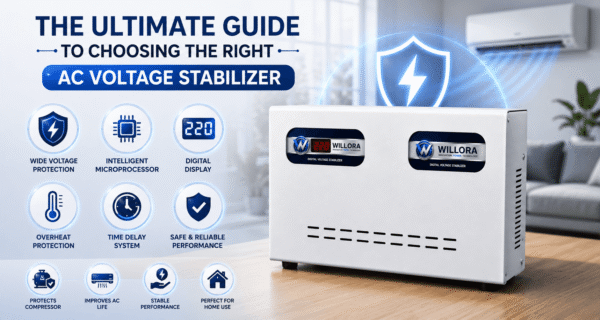
The Ultimate Guide to Choosing the Right AC Voltage Stabilizer
We’ve all been there: it’s the peak of summer, the heat is unbearable, and just as your air conditioner kicks into high gear, the lights flicker. The cooling drops, the compressor struggles, and you’re left wondering if your expensive AC is about to bite the dust. Voltage fluctuations—both spikes and brownouts—are more than just an annoyance; they are silent killers for appliances. Modern air conditioners are packed with sensitive electronic circuit boards (PCBs) and advanced compressors that require a steady flow of clean power. If you want to protect your investment and ensure uninterrupted cooling, a voltage stabilizer isn’t optional—it’s a necessity. Here is exactly how to choose the right one for your home. 1. Match the Tonnage: The Load Capacity The most critical factor in choosing a stabilizer is its capacity, which is measured in KVA (Kilo-Volt-Amperes) or Amperes. For air conditioners, stabilizer capacity is directly tied to the cooling capacity (tonnage) of the AC. If you buy an under-powered stabilizer, it will frequently trip or overheat. If you buy an over-powered one, you’re simply overspending. AC Tonnage Recommended Stabilizer Capacity 0.8 Ton to 1.0 Ton 2 KVA to 3 KVA 1.5 Ton 4 KVA 2.0 Ton 5 KVA Pro Tip: If you have a highly efficient 5-star inverter AC or live in an area with extreme voltage drops, always lean toward the higher side of the recommendation (e.g., opting for a 4 KVA stabilizer for a 1.5-ton AC) to give the system a healthy safety buffer. 2. Check the Working Range (The Input Window) A stabilizer works by “boosting” low voltage and “bucking” (lowering) high voltage to keep the output close to the standard 220V–240V range. However, a stabilizer can only correct the voltage if the incoming power falls within its specific Working Range. Before buying, you need to know how bad the voltage drops are in your locality: Check your local power conditions before buying. If your grid drops to 140V and your stabilizer’s range only goes down to 170V, the stabilizer will simply shut off to protect itself, leaving you without AC. 3. Inverter AC vs. Fixed-Speed AC: Does it Matter? A common myth is that modern Inverter ACs do not need a stabilizer because they operate across a wider voltage spectrum. While it is true that inverter compressors handle minor voltage variations better than older, fixed-speed models, their electronic PCBs are highly vulnerable to sudden, sharp voltage spikes or prolonged low-voltage strain. Repairing a fried inverter PCB can cost up to a third of the AC’s original price. The Verdict: Always pair your AC with a stabilizer, regardless of whether it is an inverter or fixed-speed model. Just ensure the stabilizer is explicitly rated compatible with inverter technology. 4. Must-Have Safety Features Don’t just look at KVA and range. A truly reliable stabilizer should act as a fortress for your air conditioner. Look for these four non-negotiable features: Smart Time-Delay System (ITDS) When power goes out and comes back instantly, the compressor needs time to balance its internal gas pressure. The Smart Time-Delay feature ensures that the stabilizer waits for 2–3 minutes before sending power to the AC, preventing compressor failure. High/Low Voltage Cut-off If the grid voltage shoots past 280V or drops below 130V (outside the working range), the stabilizer must automatically cut off power completely to prevent catastrophic electrical fires or component damage. Thermal Overload Protection If the stabilizer runs continuously under heavy loads on a hot day, it can overheat. Thermal protection detects this internal temperature rise and temporarily shuts down the unit to cool off, preventing it from burning out. Digital Display A clear digital screen that alternates between displaying the Input Voltage (what the grid is sending) and the Output Voltage (what the stabilizer is feeding the AC) gives you instant peace of mind and helps you monitor your local grid health. The Checklist: Before You Buy Before you hit “Add to Cart” or walk into a retail store, ensure you have written down these answers: Investing in the right voltage stabilizer takes away the anxiety of summer power fluctuations. It guarantees that when you turn on your AC, you get exactly what you paid for: cool, comfortable, and uninterrupted air.
The Ultimate Guide to Choosing the Right AC Voltage Stabilizer Read More »
How to Choose the Right Voltage Stabilizer for Your AC in 2026 – Complete Buying Guide
A voltage stabilizer is one of the most important accessories for protecting your air conditioner from voltage fluctuations. Even though many modern ACs include built-in voltage protection, extreme voltage variations can still damage the compressor, PCB, and other expensive components. If you’re planning to buy a new stabilizer in 2026, this guide will help you select the perfect one for your home. Why Does Your AC Need a Voltage Stabilizer? Power fluctuations are common in many areas, especially during summer when electricity demand is at its peak. A quality voltage stabilizer helps by: Without a stabilizer, repeated voltage spikes can permanently damage your air conditioner. Step 1: Know Your AC Capacity The first thing you need to know is your AC’s tonnage. AC Capacity Recommended Stabilizer 0.8 Ton 3 KVA 1 Ton 4 KVA 1.5 Ton 4 KVA–5 KVA 2 Ton 5 KVA 2.5 Ton 6 KVA Always choose a stabilizer with slightly higher capacity than your AC requirement. Step 2: Check the Input Voltage Range One of the biggest mistakes buyers make is ignoring the voltage range. A good stabilizer should work efficiently even during severe voltage fluctuations. Recommended ranges: The wider the operating range, the better the protection. Step 3: Choose the Correct KVA Rating KVA determines how much electrical load the stabilizer can handle. General recommendations: Never buy a lower-rated stabilizer. Step 4: Essential Features to Look For Modern voltage stabilizers in 2026 should include: Digital Voltage Display Shows real-time input and output voltage. Intelligent Microprocessor Provides accurate voltage correction. High & Low Voltage Protection Automatically disconnects power during unsafe voltage. Thermal Overload Protection Prevents overheating. Time Delay System Protects the compressor during power restoration. Surge Protection Protects against sudden voltage spikes. Auto Start Function Automatically resumes operation when voltage becomes normal. Step 5: Wall Mount or Floor Mount? Choose according to your installation area. Wall Mounted Floor Mounted Step 6: Energy Efficiency Matters A high-quality stabilizer consumes very little electricity while offering excellent protection. Look for models with: Step 7: Build Quality Always select a stabilizer made with: These features ensure longer life and reliable performance.
How to Choose the Right Voltage Stabilizer for Your AC in 2026 – Complete Buying Guide Read More »